
Kumbaya, Motherfucker
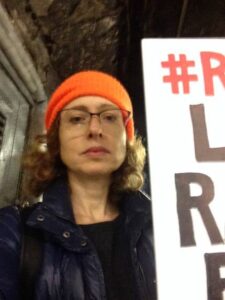
It was only Month One, and I was already so tired.
(Ed. note—In January of 2017, after Trump’s first inauguration, I began carrying a 2’ x 3’ protest sign through the streets of New York. A few weeks into this one-person protest, I started posting about it. Here’s an edited, serialized version of my posts about the five-month project I called, “Kumbaya, Motherfucker.”)
This sign-carrying has all been a selfish act. An attempt to turn my depression and hopelessness into anger and action.
I didn’t leave the house for most of November. I’m extremely lucky my life allows me to become agoraphobic and not lose my income. I couldn’t look at people’s faces on the street. I needed to wear a safety pin, or something that said I didn’t vote for him and I hated him with all my heart.
Like the day in 2015 when the news of Sandra Bland’s death broke. I couldn’t stand it, I couldn’t walk around in the world like this was a normal day. I had some mailing labels, so I grabbed one and wrote “JUSTICE FOR SANDRA BLAND,” then stuck it to the side of the cloth hat I wear.
I was on my way to my shrink that day. I stopped at a GNC to get an energy bar. Three young employees were talking urgently at the counter. When I came in, they broke apart, and one recited the scripted greeting. Then they saw my hat and the tension broke.
“This is crazy,” said one of the girls behind the register. “I can’t think about anything else. I’m so afraid, the way things are going…”
“Nobody’s doing anything about it,” said the other. “It’s like they don’t care.”
Their colleague huddled up with us at the counter and we talked about it, until the door opened and another white woman walked in. One employee gave her the greeting and they dispersed again.
“Have a good day,” I said to them, feebly. “Stay safe.”
It was the Friday after the inauguration, January 17, when the travel ban was enacted. I made a protest sign and got ready to head to the airport to protest. I made it as far as Union Square, full commuters passing through after the long, awful week, and I stopped.
I had the idea to sing Kumbaya as I held up my sign, but, like, ironically.
I already knew, from an old job that required me to bark in Times Square, how to shout in public. You start talking to yourself softly, then in a normal tone of voice, then you get louder. Then you’re shouting. But you can’t just go from silent to shouting, I can’t, anyway.
So I stood there in the cold slush singing. Desperate to get through to people. They either didn’t look at me, or looked at me like, What do you want me to do about it. And a few cheered or gave me a thumbs up.
I was out there until I was shaking from the cold. It was around 8pm by then; people were beginning their Friday nights. I headed down 14th Street towards home and groups of people clapped, said hell yeah, held up a hand for a high five. And I pulled over to lean against a building and cry because I was so grateful to be among people who agreed.
I went to a protest the next day, Saturday, down at Battery Park. As I was on my way to the train with my sign, people stopped and asked where the protest was. I was an ambassador of protest.
That Monday, I decided to carry the sign to my office, which is a short walk from my house, and then to my shrink several subway stops away.
Notable encounters: Young man of color asks me to explain why it’s bad to ban people from certain countries. I say, because they will use the ban against you. They won’t need an excuse to detain you. You won’t have due process, you won’t get to see a lawyer, they’ll just take you away because “you look suspicious.”
Thirty-ish woman with long dark hair, New Yawk accent, shows me anti-Hilary memes on her phone, I scream STEVE BANNON IS A WHITE SUPREMACIST at her.
Kids: Kids love the sign. Tweens seem to know a lot about the world. I always tell them how sorry I am for what we did. Not because I deserve forgiveness, but because it’s true – I am so sorry.
The rules of the sign evolved as such:
- I can leave it home whenever I want.
- It stays home when I’m running errands and need my hands free.
- I have to build in 10 extra minutes of travel time so I can talk to people and not be rushed.
- I look into store windows to see who’s behind me, and stop to “check my phone” every block or so to see if anyone is scoping me out.
- I have a few modes: Quiet mode, where the sign is tucked under my arm and I’m just humming to myself. Street mode, where I carry the sign in front of me and sing in a normal voice. Acknowledge everyone who passes by, nod and smile at people. If they give a thumbs up, I bow my head. Subway mode: full sign, quiet singing, unless someone disagrees with me, then LOUD singing. Park mode: Sign held high in the air, belting from the diaphragm.
- If I’m with Bill, I’m in quiet mode, or I leave the sign at home. He didn’t enlist himself for this project, and I’m not dragging him into it.
Snapshots:
The first week, when I am running on pure adrenaline, a woman bangs on the window of a coffee shop as I pass to give me a thumbs up, and I leap like a hunted gazelle.
I am going to the Brooklyn courthouse where they are hearing the arguments re: the travel ban. Walking through the mostly deserted streets, I see a white man in a suit checking his phone. It’s only me and my sign and him on the street, and I wonder what he’s going to say as I pass. He gives me a huge smile. “They just put a stop on the ban.”
My own prejudices are challenged. It turns out that not every conservative looking white guy is a Trump voter.
I hear a loud cheer from the protest and go walking as fast as I can. I need this. We all need this. Afterwards, I decide to take a cab home, and standing there hailing it, an old white cabbie rolls right by me, disgusted by my sign. I get back on the train.
I take the sign to the Alamo Drafthouse where Bill is giving a presentation on Tarantino ripoffs. In the lobby, a kid strikes up conversation. His Korean parents are pro-Trump; he has no way to get through to them. So what can he do? I want to say: Outlive them.
Bill and I go to Junior’s afterwards. Two guys in kitchen whites pop their heads out from behind the swinging doors. A very elderly man shuffles over. “I am glad to see this,” he says. He’s Trinidadian, but gets mistaken for Arabic all the time. People say hateful things to him, this elderly man.
I go to see the doctor for my anti-depressants. As soon as I enter his office and sit down, he hops up with his phone. “Great sign. GREAT sign. I have to take a picture of this.” Pause. “You probably want to get out of the shot.”
A Brazilian teenager stops me. We talk about the immigration shut-down. He was brought here as a child, and has been going through the naturalization process for 8 years, now it could all be undone. “What do I do then? I have to leave?”
I meet my father for a fancy lunch near Columbus Circle. The young hostess asks if I’d like to check my coat. I also check my sign. “I’ll take good care of it,” she promises.
After lunch, I go stand in front of the Trump Hotel and sing my song to an Orthodox Jewish woman and her two girls – Steve Bannon is an anti-Semite, kumbaya! “We love Trump!” the woman shouts. Her daughters look at me with wide eyes.
I say good afternoon to people. I smile at cops.
I am sitting on a bench in the station, a woman approaches. “Is there a protest today?” Every day, I tell her. She starts to cry. “I don’t know what we’re going to do.” I do not yet have hope but I don’t tell her that. It’s easier to be strong for someone else.
A cute boy pops his earbuds out. “Where’s the march?” Sometimes I feel like I’m in one of those musical numbers where the singer walks down the street and everyone starts following behind them. I should develop some choreography.
I arrive at Noho Star where I’m meeting David for breakfast. The hostess sees me and my sign. “He’s already here,” she says, and I wonder how she knows who I’m meeting, when I see David, wearing a sweatshirt that says, “NOT MY PRESIDENT.”
A woman standing under an awning, looking at her phone, then she spots me. She is affluent and I believe she is Jewish. I don’t know what she’s going to say.
“I can’t fucking believe this,” she demands, furious and scared, just like me. “I just want my life back.”